Your traffic is down. Your rankings aren't.
Find out why.
Organic clicks fall for more reasons than one: AI answers, SERP changes, demand shifts. This framework walks you through the diagnosis in order, then shows how to measure your visibility in AI answers, verifiable, weighted by real demand, in one report.
Rankings hold. Clicks fall. The standard report can't explain it.
The call every agency knows: "rankings are fine, why is traffic down?" The honest answer is that more than one thing changed at once. Google answers more questions directly on the results page. Some journeys now start and end in ChatGPT.
The real risk is jumping to a conclusion. Each cause has a different fix, and the wrong diagnosis can easily cost a quarter of misdirected work. So check in order, cheapest first.
Three checks, in this order.
The fork that splits the whole diagnosis: before anyone names AI, ask the cheaper question that halves the problem. Did your visibility move, or just your traffic? Hold weighted visibility next to clicks and read which one actually broke.
The cause is inside your SEO
Positions slipped, so clicks followed, the classic diagnosis (algo update, content decay, competitor gains, technical regressions) you already know how to fix better than any playbook.
The cause is outside your rankings
You kept the positions and lost the clicks anyway. The harder case, and the one the rest of this page is built for.
Rankings tell you whether you won the position; they don't tell you whether the position still pays.
Before you trust that reading, is your visibility set up to be trusted? The fork is only as honest as the keywords your tracker actually covers. Watch a slice of them and "visibility held" can simply mean the ones that slipped were never in the set. Visibility held, but on which keywords? Read it across your whole set, not a convenient sample, or the fork points you down the wrong path before the diagnosis even starts.
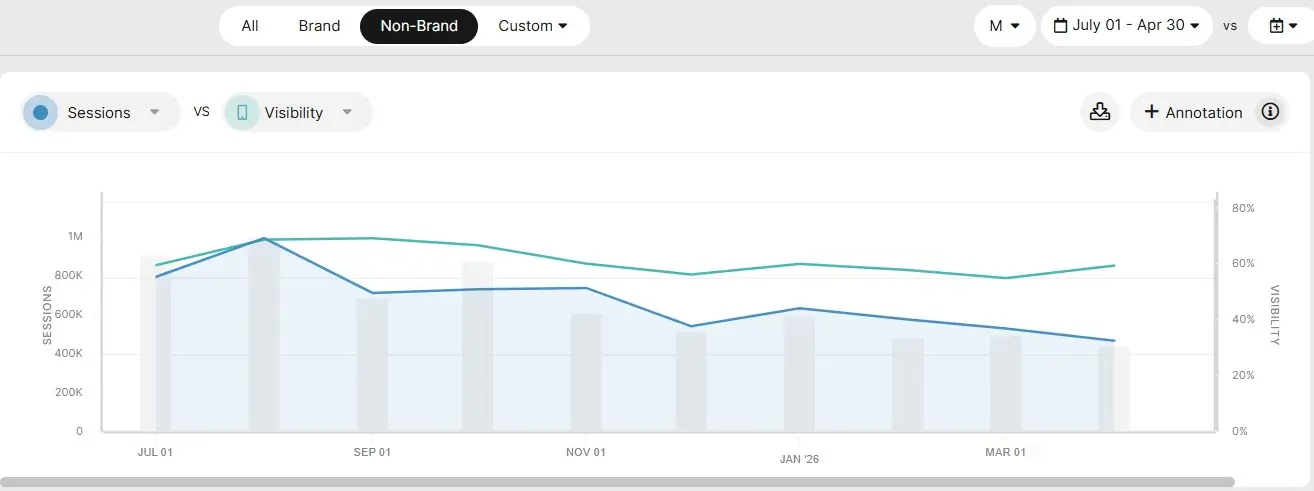
Non-brand sessions falling while visibility holds steady, the right-hand fork, in one view.
Demand itself shrank
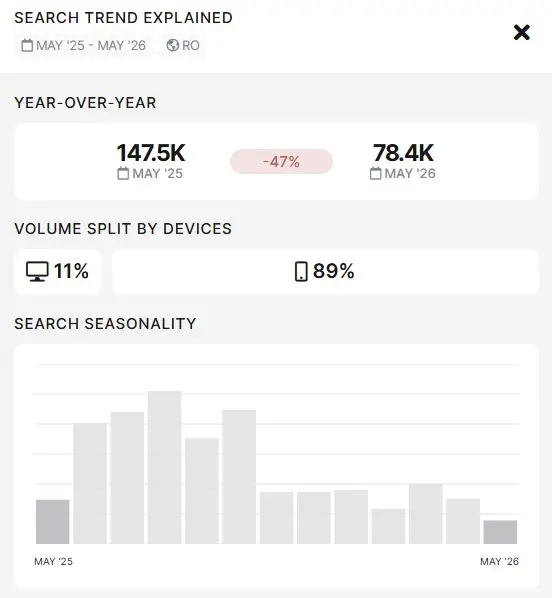
A group of keywords' search trend, year-over-year: 147.5K → 78.4K, down 47%. When the volume itself shrinks, the traffic loss is real, not a reporting effect.
The SERP answers without sending the click
When did you last buy something that mattered straight from a paragraph, without opening a single source?
Checkwhich of your keywords now trigger an AI Overview, and whether you are cited in it. Ranking still matters. Strong SEO is often the base the model cites from, though not the only one. But it's no longer the whole question: now you also ask whether you're in the answer. Being cited is the new visibility; being absent while you rank #3 is the new invisible loss.Measure the click, not just the rank: percentage of clicksbetween "we still rank" and "AI took it" sits a measurable middle ground: the SERP itself. AI Overviews and other features reshape the page around an intact position and quietly absorb the click share a #1 used to earn. Track how the click share on your keywords evolves as the SERP design shifts, and "AI probably took our traffic" becomes a number you can defend: this keyword, this feature, this much of the click, gone on this date.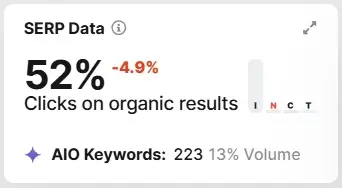
In this example, only 52% of clicks across 266K searches still reach the organic results. The SERP keeps nearly half.
The journey never touches Google
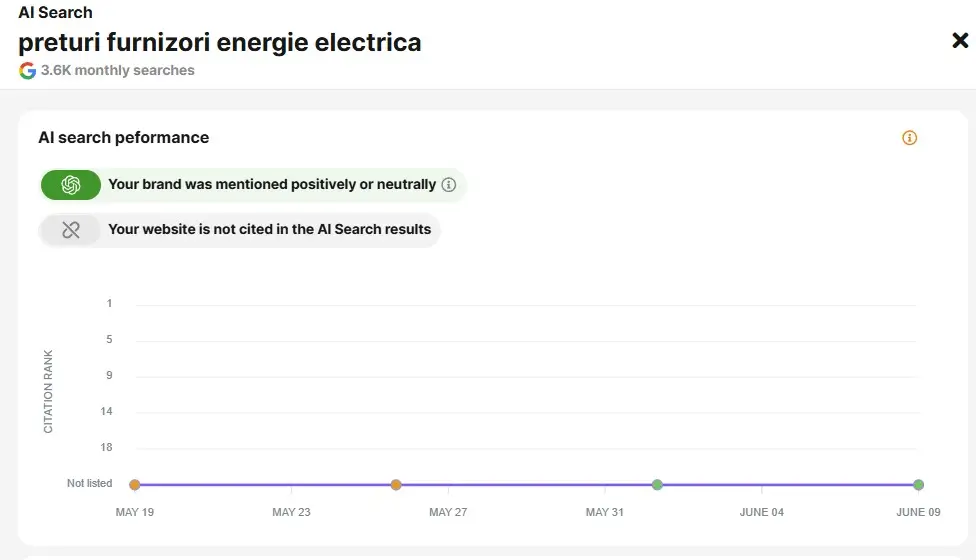
In ChatGPT this brand is mentioned, positively or neutrally, yet not cited, so no link is sent. A Google report shows none of it; only measuring the AI answer reveals the gap.
Measure AI Search the way you already measure Google.
No new methodology, no second dashboard: the unit that works, the metrics that matter, and the principles that keep them honest.
Track keywords, not promptsPhrasings shift constantly; the intent behind them rarely does. An LLM can resolve thousands of prompt variations into a single keyword, but the discipline requires isolating one primary intent per keyword.+
Phrasings shift constantly; the intent behind them rarely does. An LLM can resolve thousands of prompt variations into a single keyword, but the discipline requires isolating one primary intent per keyword. Phrasings with the same directional intent collapse together; phrasings that pivot to a different intent get their own track (e.g., "SEO forecasting tool" for selection vs "how to forecast SEO traffic" for learning). Each keyword is anchored to a single intent and verified Google search volume, keeping your metrics honest and focused.
Three core metricsMentions · Citations · Share of Voice+
How often the model names you, with what sentiment, and against which competitors. This is the touchpoint that reaches the end user: being named in the answer is what shapes their perception, whether or not they ever click a source.
Whether the model relies on your pages as evidence, and how high you rank within its source list. A citation is an authority signal: how much the model trusts you as a source. It's also a lever, since being cited gives you a way to shape what the answer actually says.
How your mentions and citations combine against competitors, weighted by user demand. This provides a clear picture of your visibility across AI responses, a key metric for your client report.
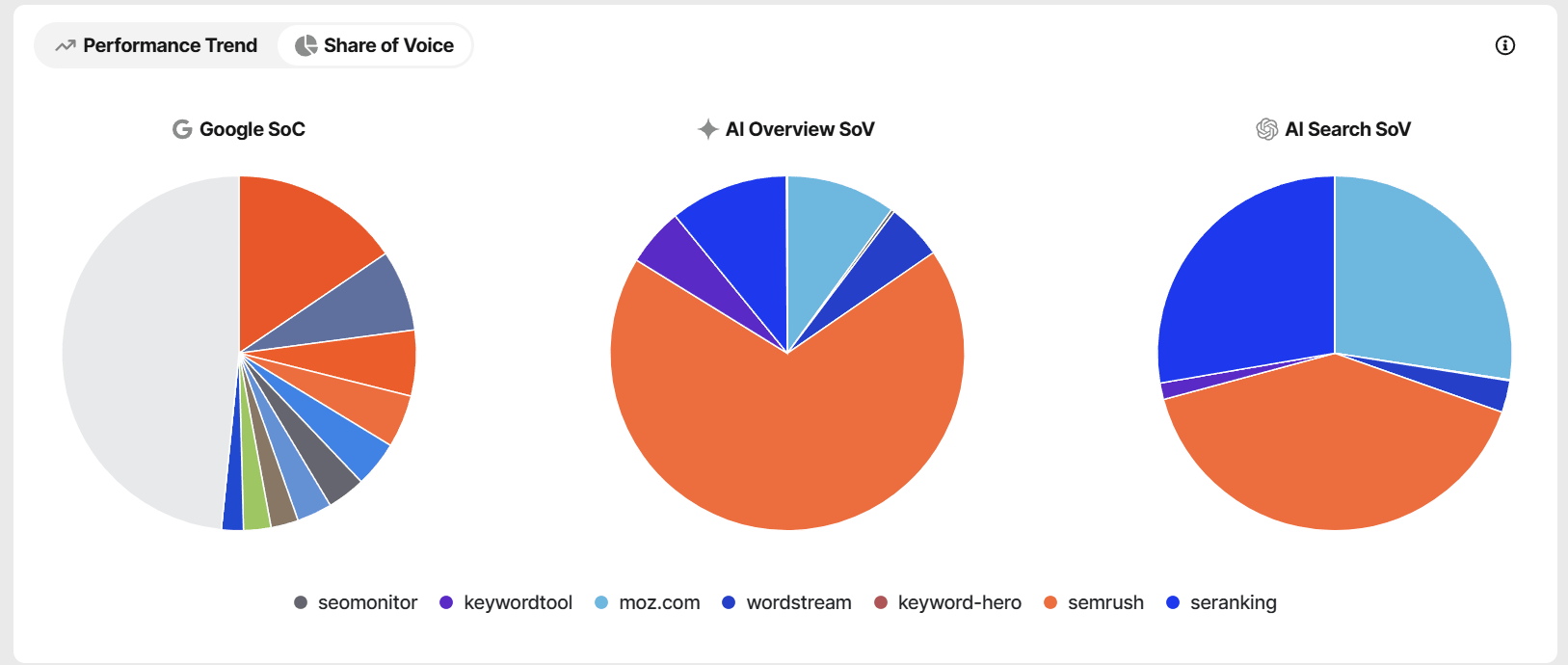
The same competitive picture, surface by surface: your share on Google, in AI Overviews, and in ChatGPT, against the competitors that matter. The one figure you actually report.
Demand-weighted, alwaysMentioned for 10 queries worth 100 searches, or 1 query worth 10,000? The second matters more, and your mention rate should reflect it. No vanity counts.+
Mentioned for 10 queries worth 100 searches, or 1 query worth 10,000? The second matters more, and your mention rate should reflect it. No vanity counts.
Ten queries, 100 searches combined. Looks busy; the demand behind it is small.
One query, 10,000 searches behind it. One mention, 100× the real demand. That's what should win.
Anchor to Google search volume, not clickstream guessesWeighting is only as honest as what you weight by. Prompt-volume estimates and clickstream panels are samples that wobble run to run.+
Weighting is only as honest as what you weight by. Prompt-volume estimates and clickstream panels are samples that wobble run to run; Google's search volume is the one demand signal consistent at scale and defensible to a client or a CFO. If someone asks where the weighting came from, can you point to a verifiable source, or only to an estimate that changes the next time you ask? This is the anchor every other number hangs on.
Coverage is the denominator most setups skipWeighting tells you which mentions matter; coverage tells you whether you're measuring enough of the market for the number to mean anything.+
Weighting tells you which mentions matter; coverage tells you whether you're measuring enough of the market for the number to mean anything. A 20,000-keyword e-commerce catalog measured through 2,000 long-tail prompts isn't measuring its market. It's sampling a corner and reporting it as the whole. If your catalog has 20,000 keywords and your tool tracks 2,000 prompts, whose visibility are you really reporting? Track a set wide enough that the figure represents the business, not a fraction you happened to pick.
Track the channels that matter, not every LLMChatGPT and Google's AI Overviews are where the volume, and the decisions, actually sit, so that's where you measure.+
ChatGPT and Google's AI Overviews are where the volume, and the decisions, actually sit, so that's where you measure. Pull in Gemini or Perplexity when a client or a market calls for it. Tracking every LLM just multiplies cost and noise for a signal that barely moves.
The method is sound. By hand, it doesn't scale.
Everything to this point is something you could, in theory, do yourself. Open ChatGPT. Type a query. Read the answer. Note whether you're mentioned, and how. Scroll the sources to see if you're cited, and where you rank among them. Then do it again. The answer shifts from one run to the next. Now repeat across 500 keywords. Weight each by its Google search volume. Track your competitors in the same pass. Do the whole thing again for AI Overviews. Paste it into a spreadsheet. Refresh it every week.
It's not that it's impossible. It's that it can't hold the scale, the cadence, or the consistency a client report needs. One person with a spreadsheet can sample a corner of it. No one's going to run it across the whole market, every week, by hand.
Everything above, already assembled.
SEOmonitor puts the data behind the whole framework in one place: the signals you run the diagnosis with, and the AI-side measurement a Google report leaves out, anchored to Google search volume, unified with your Google performance, and refreshed every week.
Every screen on this page is a real SEOmonitor view: the visibility-vs-traffic fork, the SERP click share, the ChatGPT mentions and citations, the Share of Voice across channels. The picture comes assembled, not pieced together by hand.
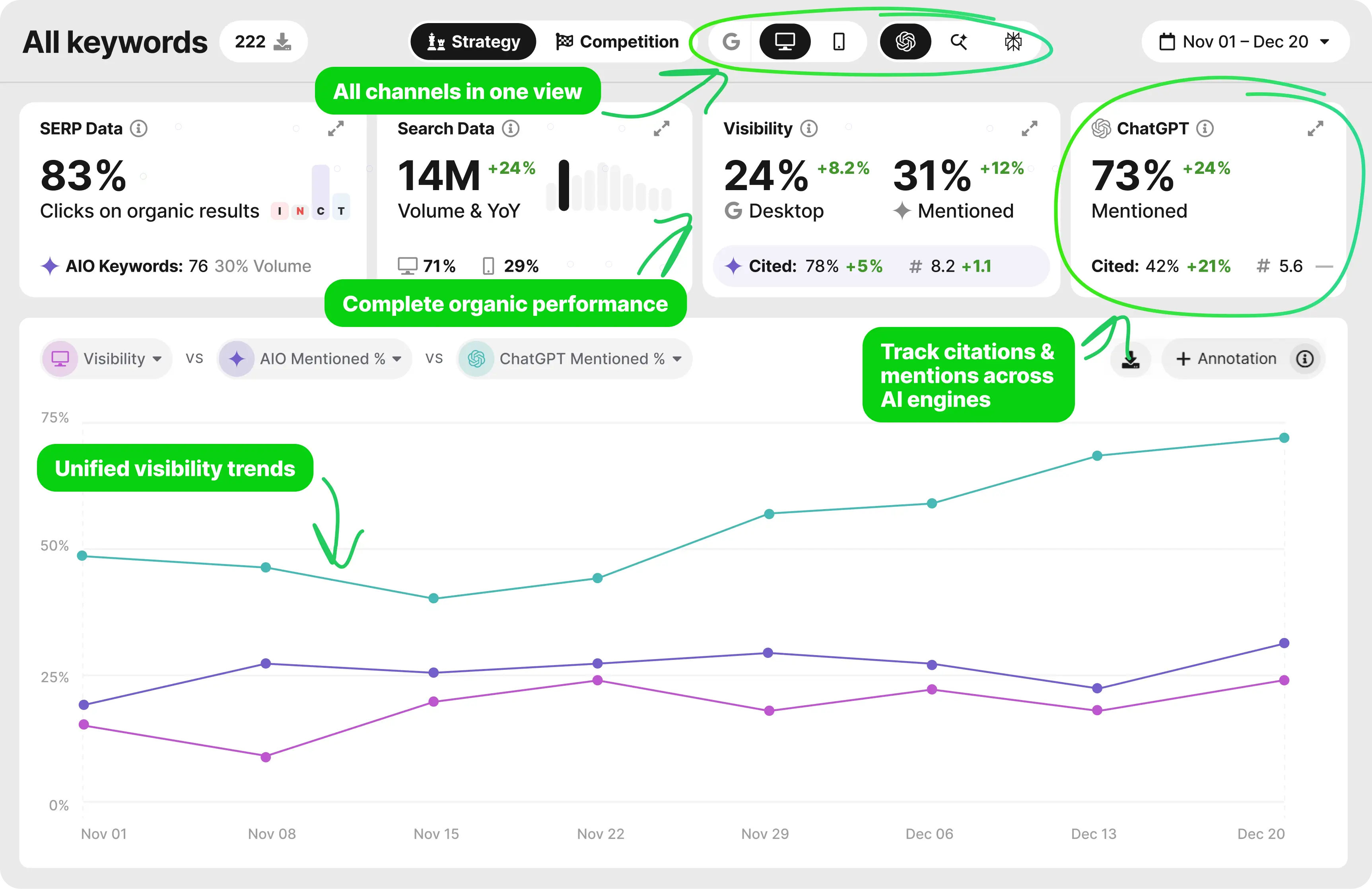
Every signal from this page in one screen: organic click share, demand, Google visibility and AI mentions, side by side, refreshed weekly.
What it gives you
- The signals you diagnose with: visibility vs traffic, SERP click share, demand trends
- AI-side measurement: mentions (with sentiment), citations (with rank), Share of Voice, across AI Overviews and the LLMs you choose to track (ChatGPT, Gemini AI Mode, Perplexity), demand-weighted, anchored to Google search volume, with real coverage
- Unified organic performance reporting: Google, AI Overview, AI Search
Stop piecing it together by hand.
The whole framework, assembled in one dashboard and refreshed weekly.
Turn the numbers into a story the business trusts.
AI visibility is a leading indicator, if it correlates with your lagging numbers. Today's mentions can become next quarter's branded searches, and the conversions that follow. Connect, don't force. The link is a correlation you build over months, not a click-to-revenue line.
How it can play out, one plausible path, shown as an example, not a promise:
AI visibility
Leading
Mentions, citations and share of voice grow across ChatGPT and Google's AI Overviews.
Branded search lift
Bridge
Users hear your brand from an AI, then Google it directly.
AI referral & conversions
Lagging
AI referrals in GA4, assisted conversions, self-reported discovery. Visitors arrive already informed.
Three evidence paths to start with, none of them a click-to-revenue line:
Watch both segments move together
The model mentions you without linking; the user Googles your name. Track branded/direct vs non-branded and look for correlation.
Catch AI referral traffic in GA4
ChatGPT, Perplexity and Gemini are starting to show in referral reports. Small volumes, but already-informed visitors.
"How did you hear about us?"
Add it to your forms. "I asked ChatGPT" is direct evidence analytics can't track.
Show the logic before you prove the correlation. Tie it to brand-uplift metrics the business is more likely to trust (recall, consideration, sentiment) rather than forcing a clean click-to-revenue line that's hard to defend.
AI Search, answered.
What is AI Search?+
Should I track keywords or prompts?+
How do I track ChatGPT mentions?+
Which LLMs should I track?+
Does AI Search replace Google SEO?+
Does SEOmonitor work alongside my Google SEO, or is it a separate platform?+
Are SEOmonitor's AI-visibility numbers solid enough for a client report?+
Before you pay for a prompt-tracking tool, ask one question: can you verify the data?
If the volume is "estimated by an AI model," verification is nearly impossible, making it incredibly difficult to defend to a client or a CFO who demands hard data. SEOmonitor gives you a number you can stand behind.
"An AI-visibility KPI is a leading metric. It only earns its place if it correlates with the lagging numbers: direct, branded organic, AI referral."
Cosmin NegrescuFounder, SEOmonitor